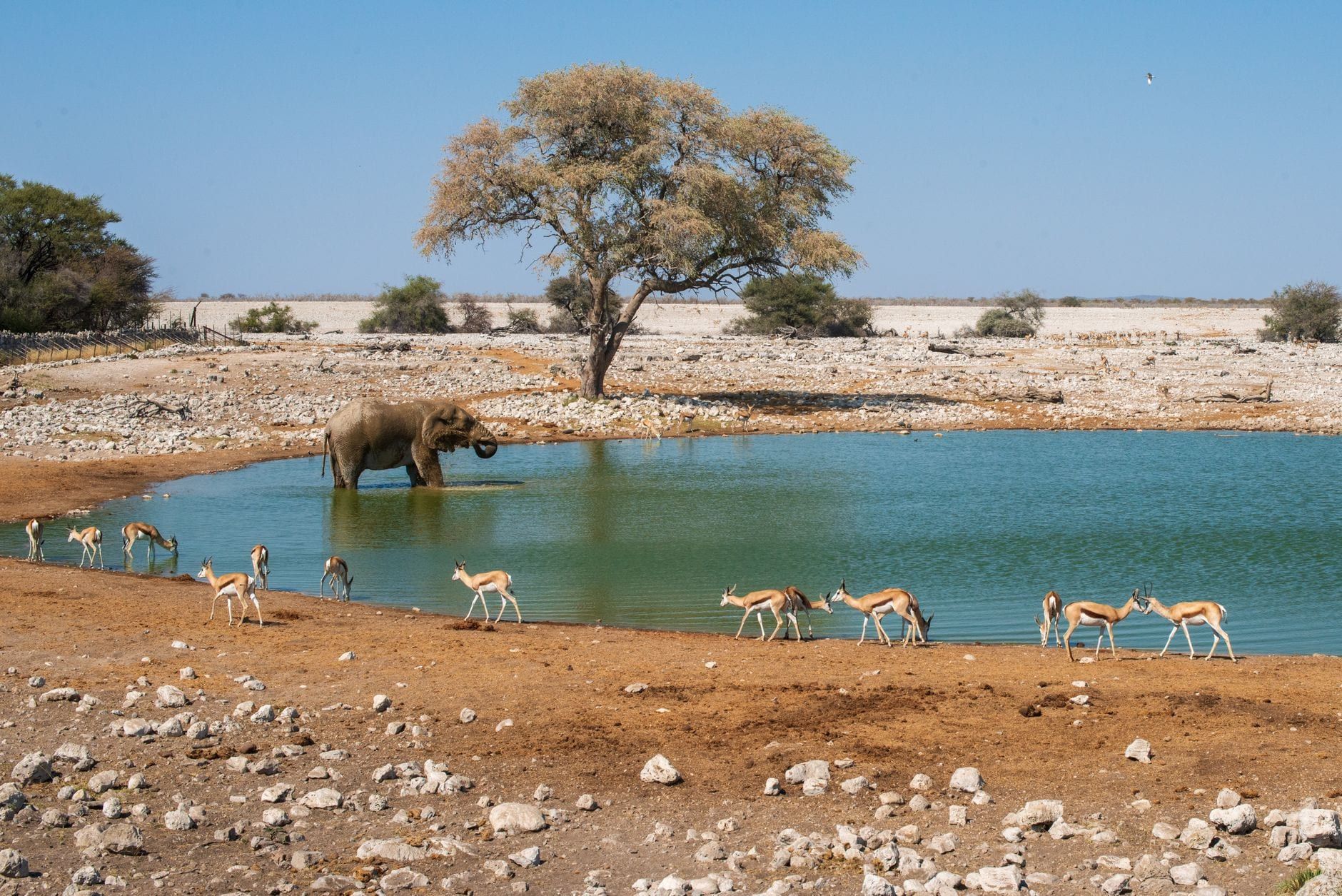
Etosha National Park doesn't work like most safari parks. Across 22,935 km² of northwestern Namibia, the animals come to you — or rather, to 86 waterholes scattered around a salt pan the size of a small country. In the dry season, when the bush holds no water, everything that walks has to drink somewhere, and the gravel roads link those somewheres like a string of theatres. You park, you wait, and the stage fills.
The cast is large: 114 mammal species and more than 400 recorded birds, including four of the Big Five, the world's largest black rhino population, and 2,500 elephants that glow white with pan dust. This guide covers what actually lives here, what you realistically will and won't see, and the waterholes and hours that decide your odds. If you're still weighing Etosha against other parks, the honest scorecard below is the place to start.
Etosha's Wildlife at a Glance
Start with the numbers, because they set expectations. Etosha covers 22,935 km² of Kunene-region savanna, anchored by the Etosha Pan — a 4,730 km² salt flat, roughly 130 km long and up to 50 km wide, that is dry for most of the year. Around its edges live 114 mammal species, from lion down to bat-eared fox and ground squirrel, plus 407 recorded bird species, about a third of them migratory.
Now the caveat every visitor should know before booking: Etosha offers four of the Big Five, not five. Lion, leopard, elephant and rhino are all present — and the rhino story is extraordinary — but there are no buffalo, no hippos and no crocodiles. The park is arid and spring-fed; there are no permanent rivers to support them. Wild dogs don't occur here either. If a full Big Five tick matters to you, Namibia's Zambezi region in the far northeast is where buffalo live. A fairer framing of Etosha is "Big Four plus cheetah" — and for rhino, it beats almost anywhere on the continent.
The pan explains everything else. Heat mirages make the white floor look flooded even in drought, and the surrounding grassland and mopane scrub hold almost no surface water. That single fact shapes how the animals behave: they range widely to feed, then converge daily on the waterholes. You can read more about the park's layout and history on our Etosha overview page.
Big Cats and Other Predators
The honest odds: lions are likely, cheetahs are a genuine possibility in daylight, and leopards are mostly a matter of luck. Etosha's predators suit different hours and different terrain, so here's a species-by-species breakdown of how to hunt for each one.
Lion
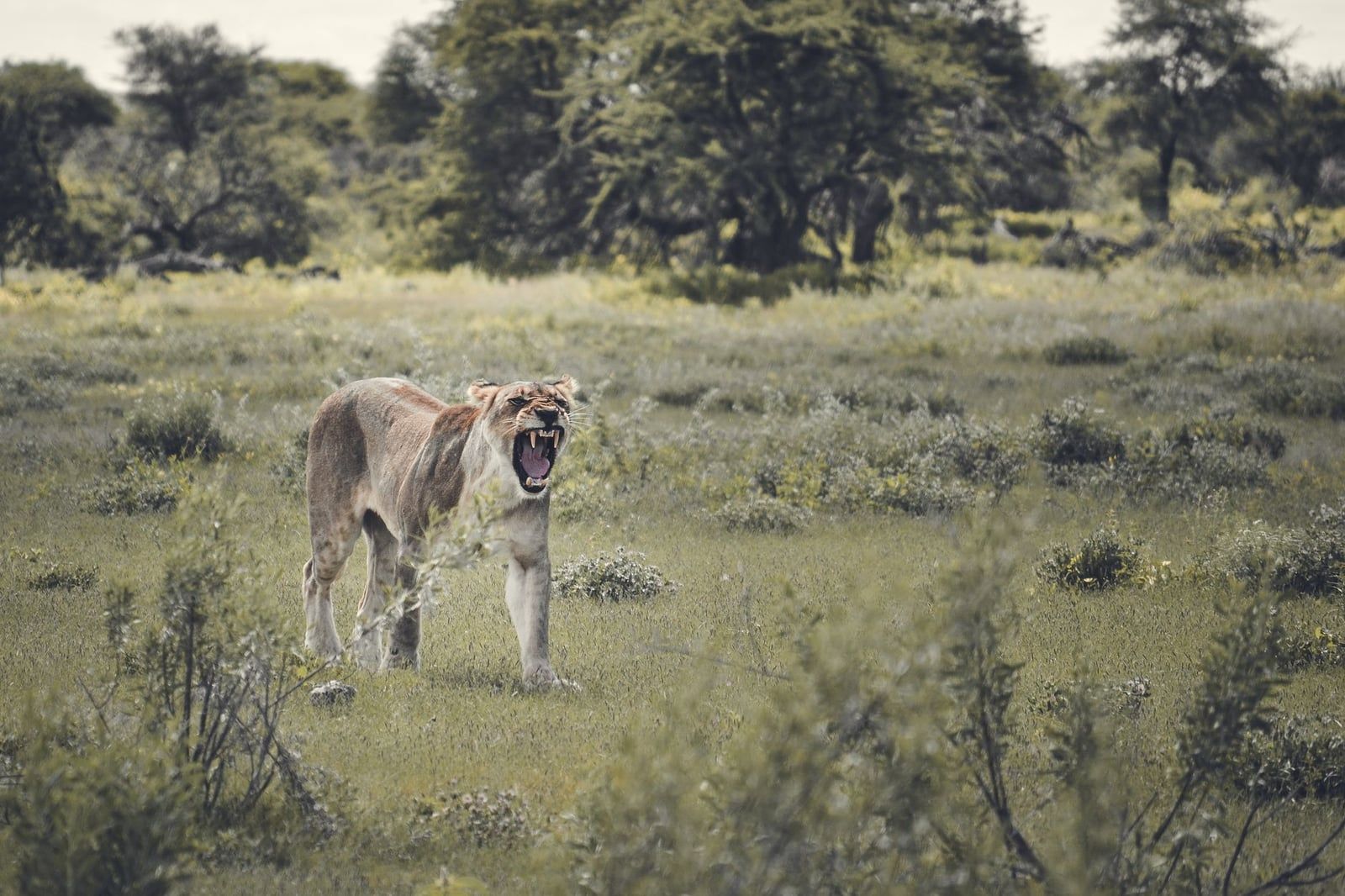
Lions are the big cat you're most likely to see. A 2018 survey estimated 335 lions in the park, down from a 1980 high of about 500 but enough that prides work the pan edge and the open dips along the southern and central roads. They're most active in the cool hours — be first through the gate at sunrise, or work your way back to camp in the last hour of light. Etosha's lions have a conservation distinction too: they're notably free of feline immunodeficiency virus, which infects much of Africa's lion population, making this population scientifically valuable.
If a kill happens near a waterhole, expect a traffic jam. Otherwise, scan the shade under the thorn trees along the roads near Salvadora and the pan's southern edge, where prides doze between hunts.
Leopard
Leopards live here in decent numbers, and you will probably not see one. They're nocturnal, secretive and partial to the rocky koppies and dense mopane near Halali camp, the park's only real high ground. Your best odds are dawn and dusk on the roads around those hills — or, after dark, from the benches at a floodlit waterhole, where leopards occasionally drink. Budget a leopard sighting as a bonus, not a plan.
Cheetah
Cheetahs are Etosha's best daylight predator bet. They hunt by day, favour the open plains of the western and central zones, and habitually scan their surroundings from termite mounds — a habit that makes them easy to spot if you drive slowly and check every mound with binoculars. Namibia holds one of the world's largest cheetah populations, and Etosha's open terrain suits them perfectly. Morning is prime time, before the heat flattens the hunting.
Hyena, jackal and the small carnivores
Spotted hyenas are nocturnal; look for them loping the roads just after sunrise or before sunset, and listen for their whooping around the camps at night. Black-backed jackals are an everyday sighting — pairs trot the roads at dawn, unbothered by vehicles. Bat-eared foxes, with their enormous radar-dish ears, dig for termites on the open flats in the early morning. Honey badgers turn up around the camps after dark. These smaller carnivores get skipped by most visitors racing between waterholes, and they're often the most entertaining sightings of the day.
Rhinos, Elephants and Other Big Game
This is where Etosha earns its reputation. The rhino population is the strongest in Africa, the elephants have a comeback story few parks can match, and the giraffe, zebra and wildebeest are so reliable they'll frame every day of your visit.
Black rhino
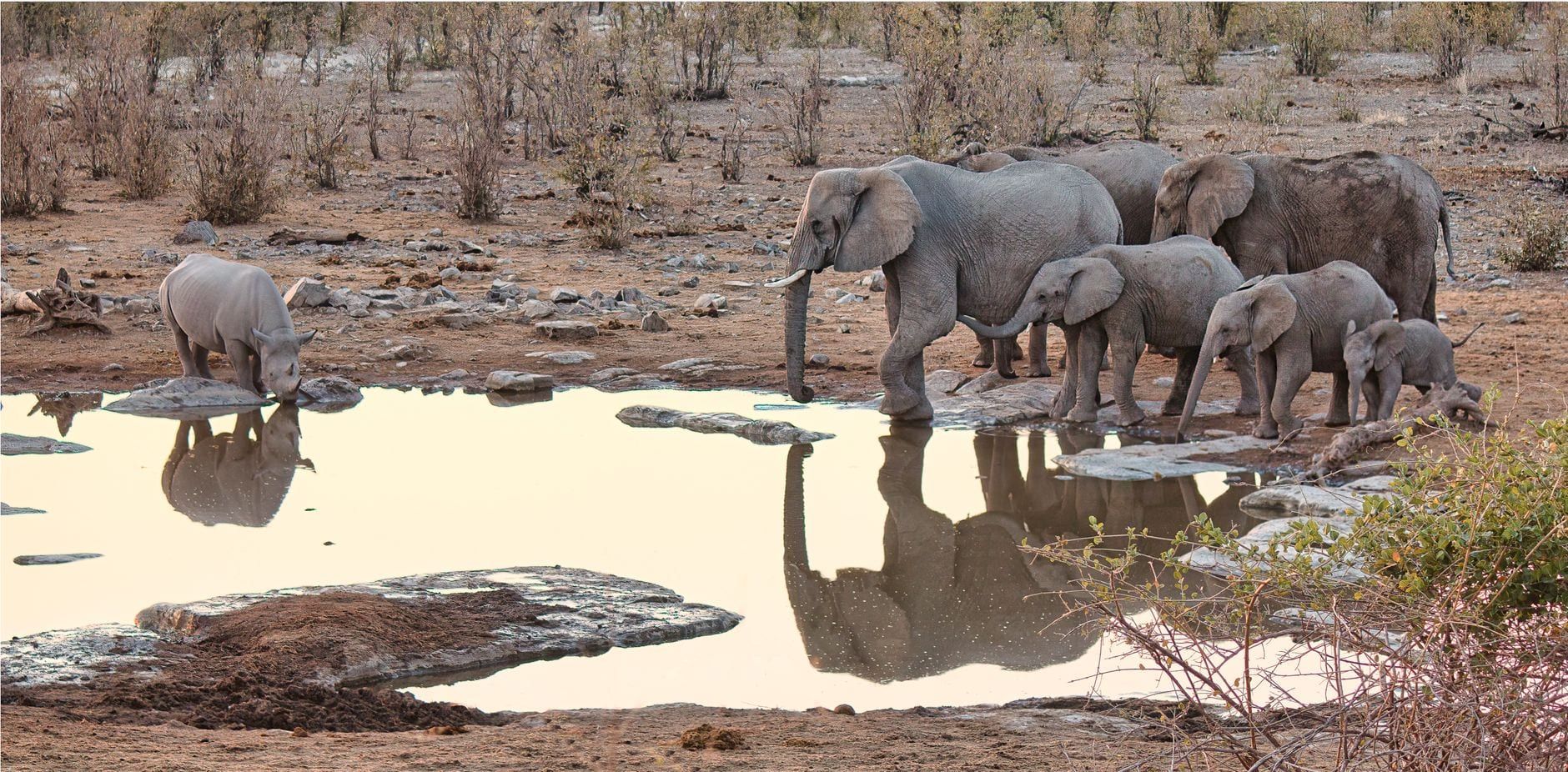
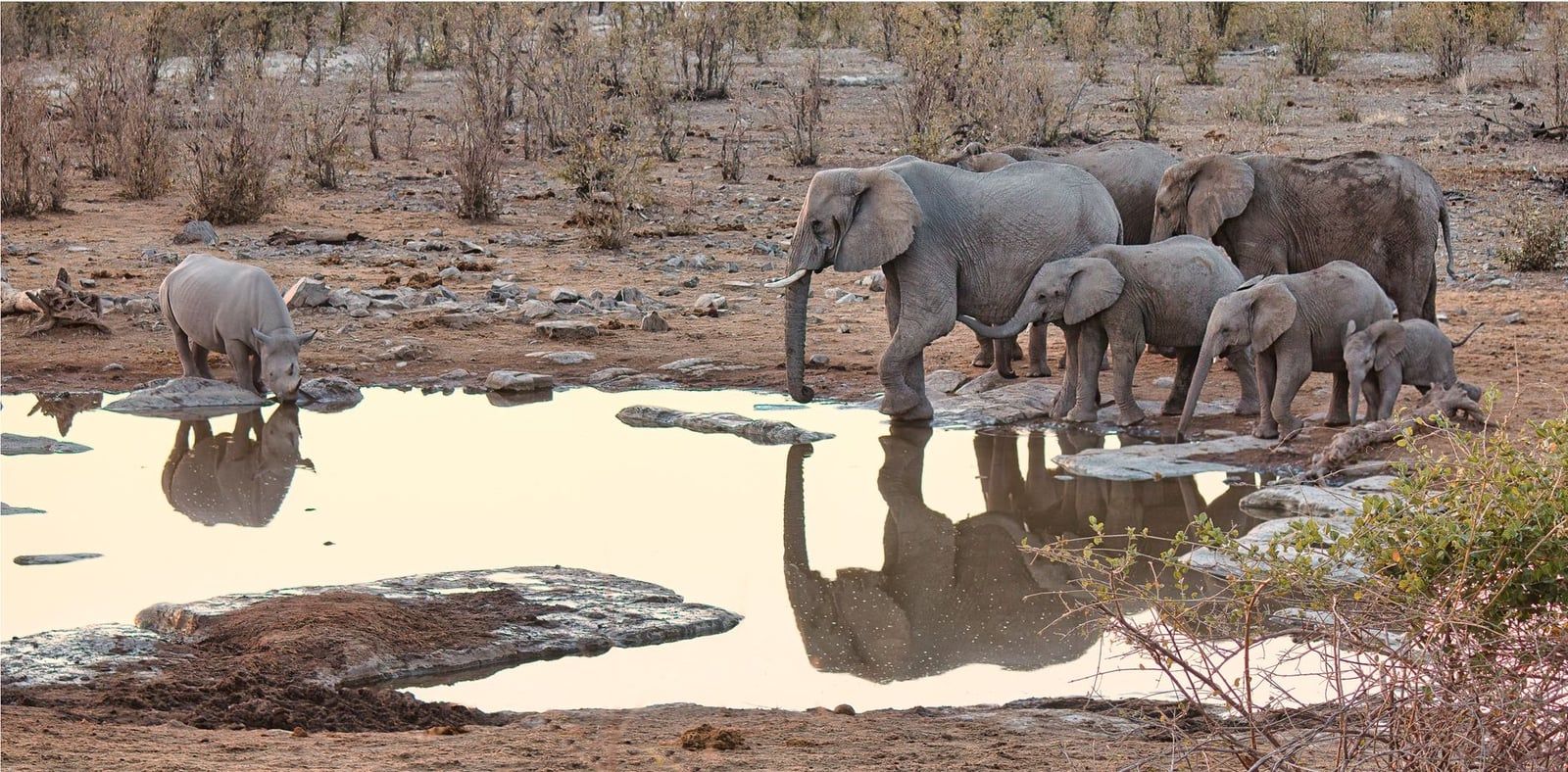
Black rhino are Etosha's single greatest wildlife claim. The park holds the world's largest population — roughly 70% of Namibia's approximately 2,200 animals, itself over a third of Africa's total. The exact count is kept secret for protection reasons, and poaching pressure is real, which is why ID checks at the gates are strict. Critically for visitors: black rhino drink at night, and the rest camps' floodlit waterholes — Okaukuejo's above all, and Halali's Moringa — are among the most reliable places in Africa to watch one. Many visitors rate a single evening at Okaukuejo as the highlight of their trip.
White rhino
White rhinos were reintroduced from South Africa's Kruger National Park in 1995 and live in the area around Namutoni camp in the east. Don't build an itinerary around them — sightings are rare. And if you're wondering about the names: neither species is white or black. "White" comes from the Afrikaans wijd (wide), describing that species' wide, grazing mouth. Both are grey.
Elephant
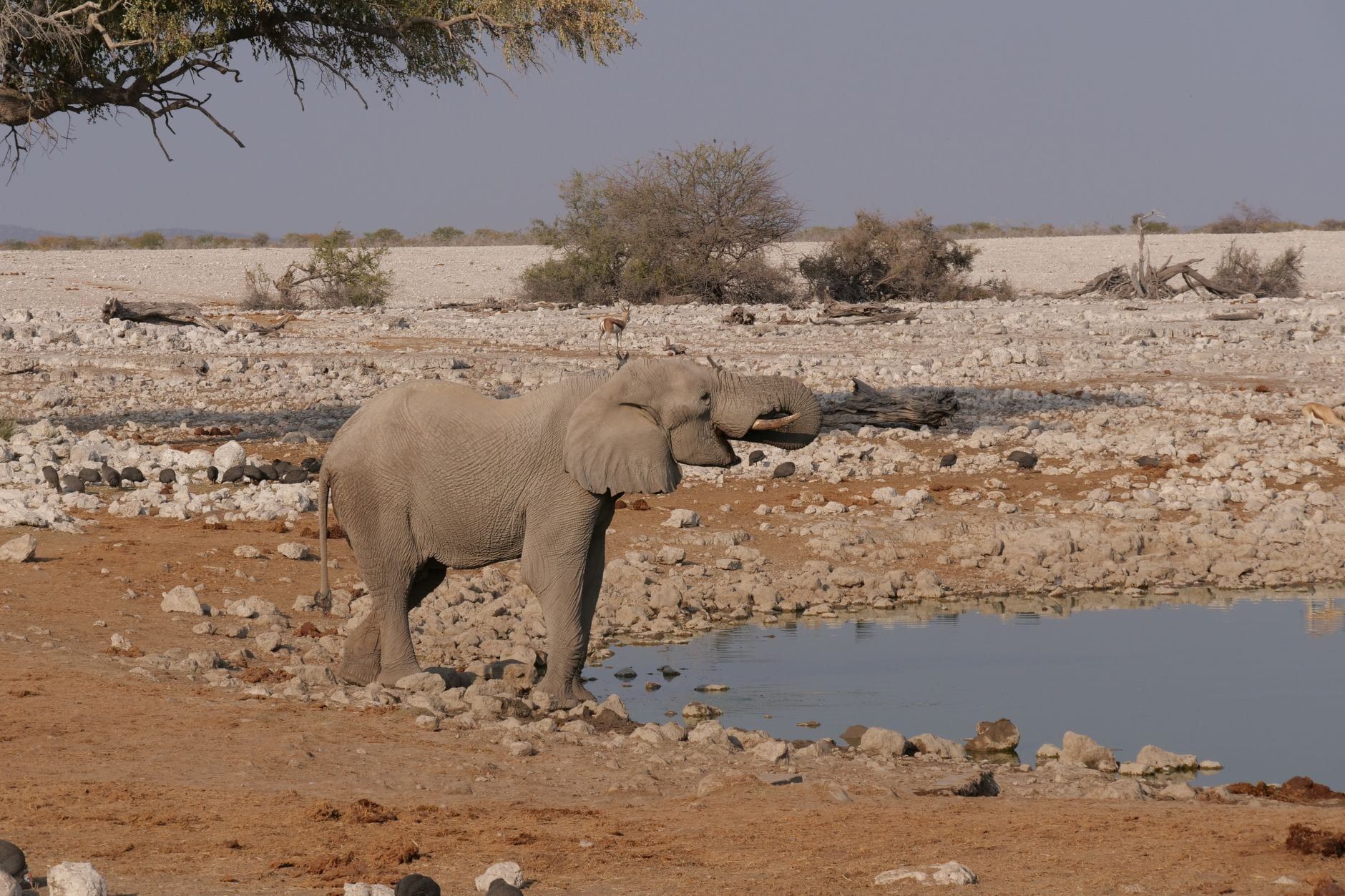
Elephants are a dry-season certainty at the big waterholes. The population crashed to 26 animals in 1954 before boreholes drew them back; today more than 2,500 live in the park. They coat themselves in the pan's white clay, which is how they earned the nickname "ghosts of Etosha" — pale herds materialising out of the dust at Goas or Rietfontein. Big breeding herds drink in the mornings and late afternoon; in September and October, dozens at a time queue at the popular holes.
Giraffe, zebra and wildebeest
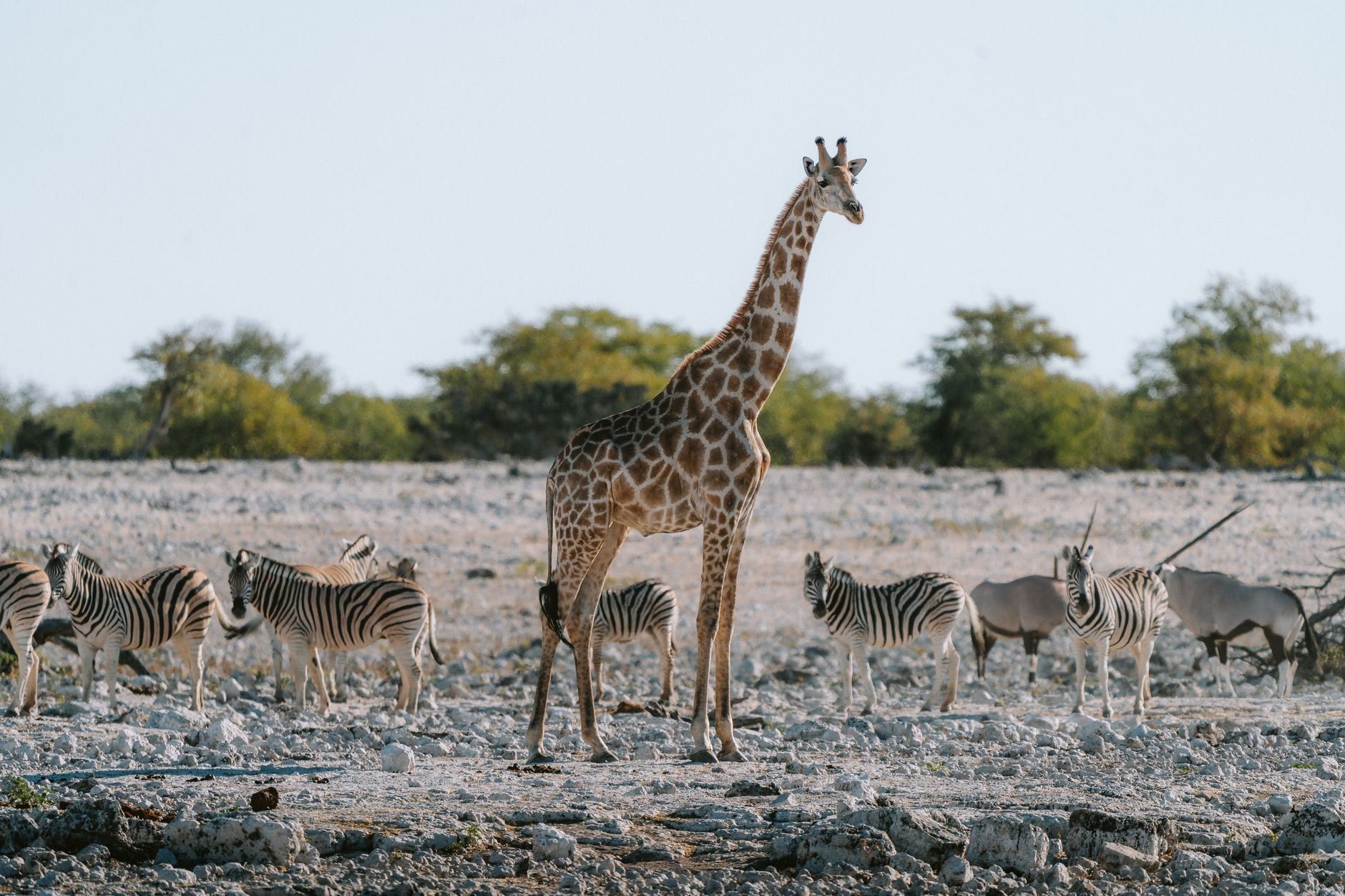
Giraffe are everywhere and never stop being entertaining. Watch for the drinking act: a giraffe has to splay its front legs like a tripod to reach the water, a slow, awkward manoeuvre that takes nerve when lions are around. Two zebra species occur — Burchell's (plains) zebra across most of the park in large herds, and the rarer Hartmann's mountain zebra in the rocky western hills. Blue wildebeest gather alongside zebra and springbok in the dry season, and the mixed herds along the pan's edge are the classic Etosha photograph.
Antelopes, Smaller Mammals and Etosha's Rare Species
Etosha's antelope list runs long, and two of its species barely exist anywhere else on Earth. Beyond the headline game, the smaller mammals — dik-diks, badgers, foxes — are what keep a slow midday hour interesting.
Springbok, oryx and the plains antelopes
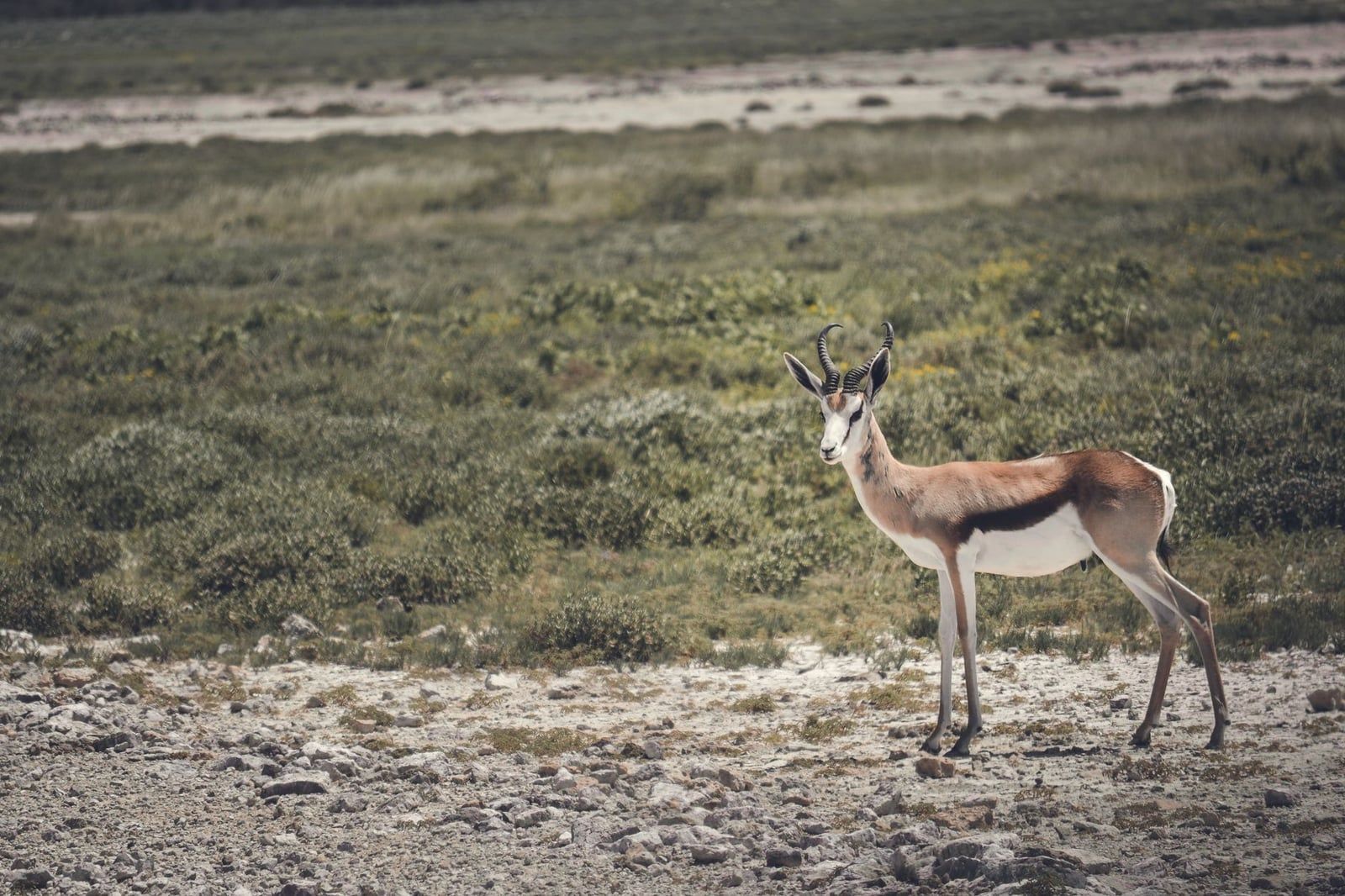
Springbok are the most numerous antelope in the park and can hit 90 km/h when they choose to run. Their vertical "pronking" leap — bouncing stiff-legged with all four feet off the ground — is a regular sight when a herd is nervous. Oryx (gemsbok) are the quintessential Etosha animal of the pan edge and mopane woodland: straight rapier horns, black-and-white faces, and the ability to survive almost without drinking water. Kudu haunt the denser woodland, and eland and red hartebeest roam the open country in smaller numbers.
Black-faced impala and Damara dik-dik
Two near-endemic species reward visitors who venture beyond the central circuit. The black-faced impala — a dark-masked subspecies found only in Namibia and southwestern Angola — is reliably seen around Dolomite Camp in the restricted west, which holds the park's best population. In the east, the woodland between Namutoni and Von Lindequist Gate is home to the Damara dik-dik, one of Africa's smallest antelopes at under 39 cm tall. Dik-diks are monogamous, territorial and usually found in pairs, standing motionless at the roadside until you pass.
Warthogs, small mammals and ostrich
Warthogs trot between waterholes with tails erect like antennae. Ground squirrels use their tails as sunshades, jackals and bat-eared foxes cover the predator beat above, and honey badgers raid the camps at night. On the open plains, ostriches — nearly 2 m tall, the world's largest birds — are constant companions to the zebra and springbok herds. A male ostrich in full breeding display, knees trembling and neck flushed crimson, is worth stopping for.
Birds: The Overlooked Side of Etosha
Birders get shortchanged by most Etosha write-ups, which is odd given the numbers: 407 recorded species, about a third of them migratory, including 35 birds of prey and eight owl species. Even dedicated mammal-watchers notice. Lilac-breasted rollers sit on every second bare branch, hornbills rustle through the mopane, and kori bustards — the world's heaviest flying birds — stalk the plains like dignitaries. Watch the sky for martial eagles, Africa's largest eagle, and bateleurs tilting over the grassland.
Flamingos on the pan
The spectacle is the flamingos. When summer rains — roughly November to March — fill the Etosha Pan and Fischer's Pan in the east, tens of thousands of greater and lesser flamingos arrive to breed on the ephemeral water. In a good year it's one of southern Africa's great wildlife events; in a drought year, the pan stays empty and white. Pelicans move in too. It's the single strongest reason to visit Etosha in the green season, and you can time it with our guide to the best months to visit.
Sandgrouse provide the other signature birding moment. At dawn, flocks of sandgrouse descend on certain waterholes in their hundreds — a whirring, jostling spectacle that lasts minutes and is over by mid-morning. The males soak their specially adapted breast feathers to carry water back to chicks waiting kilometers away. Be at a waterhole early to catch it.
How and When to See the Animals: Waterholes and Seasons
Waterholes are the engine of Etosha's game viewing. Most are natural springs; others are pumped — many solar-powered — and maintained year-round, which is exactly why dry-season viewing here is so predictable. When the bush dries out from May onward, the animals have nowhere else to go. Herds queue, predators follow the queues, and a visitor who parks at the right hole at the right hour is essentially fishing in a barrel. Our fuller Etosha safari guide covers the driving; here is the animal-side strategy.
The table below pairs the standout waterholes with the animals they're known for. Note the last two entries sit on the eastern side of the park, near Namutoni.
| Waterhole | Nearest camp / region | Known for | Best time |
|---|---|---|---|
| Okaukuejo | Okaukuejo (floodlit, in-camp) | Black rhino at night; elephant, lion after dark | After sunset |
| Moringa | Halali (floodlit, in-camp) | Rhino and elephant drinking after dark | After sunset |
| Salvadora | Central, west of Okaukuejo | Lion prides near the pan edge | Dawn and dusk |
| Rietfontein | Central-east | Elephant herds and the predators that follow | Morning |
| Goas | Central-east | Large elephant herds in dry season | Morning |
| Chudop / Fischer's Pan | East of Namutoni | Predators at Chudop; flamingos on the pan when it fills | Morning / wet season |
Floodlit waterholes are the trick most first-timers miss. Driving at night inside the park is illegal — but the camps at Okaukuejo, Halali and Namutoni have illuminated waterholes a short walk from the restaurant, where rhino, elephant, lion and hyena come to drink meters from the benches. Okaukuejo's is the most famous, and the waterhole chalets put it on your veranda. This is why where you sleep inside the park matters as much as where you drive: guests in-camp get first light at the gate and wildlife all night, while lodge guests outside the fences commute in after opening.
Seasons split the experience cleanly. Here's the trade-off:
| Dry season (May–October) | Wet season (November–April) | |
|---|---|---|
| Game viewing | Excellent — animals concentrated at waterholes, July–October peak | Poor to fair — animals disperse across the park |
| Landscape | Dust, dry grass, hazy air in September–October | Green, dramatic skies, thunderstorms |
| Birds | Resident species only | Best — migrants arrive, flamingos may breed on the pan |
| Special sights | Big herds queuing to drink; predators at waterholes | Newborn animals, including impala and springbok lambs |
| Crowds and heat | Busiest July–October; October very hot | Quietest; hot and humid, heaviest rain January–March |
Time of day matters as much as month. The pattern: drive hard for the first two hours after the gates open, when predators are still moving and herds drink. Midday goes quiet — use it for the camp pool, or park at a big waterhole anyway, because elephant herds don't read schedules. Then work the waterholes again from mid-afternoon until you must head back. Every camp keeps a sightings logbook at reception, where visitors record what they saw, where and when — read it at breakfast, and add to it in the evening. Etosha rewards patience over distance: one hour parked at a productive hole beats three hours of driving.
Seeing Animals Responsibly: Park Rules That Affect Sightings
A handful of rules shape every sighting in Etosha. The speed limit is 60 km/h, and you should drive 20–40 km/h wherever animals are present — Etosha's gravel roads are corrugated and animals dart across them. You must stay in your vehicle at all times, except inside rest camps and at designated rest areas; animals have right of way everywhere. Off-road driving is prohibited and can cost you your vehicle.
Give elephants and rhinos extra room — a car that crowds a breeding herd or a rhino with a calf can be damaged or flipped, and it happens every year. Keep quiet at the waterholes, too; noise clears them out for everyone. If you're travelling with a drone, declare it at the gate: drones are prohibited throughout the park, are sealed in storage on entry, and are returned when you leave. No exceptions.
Gates open at sunrise and close at sunset, and the times change weekly — early September runs about 06:55 to 18:50, late December stretches to 19:35. Times are posted at each gate and at camp reception; check them every morning, because the penalties for lateness are real (a fine, or a night locked outside the fence with lions). Entry permits are bought at the gate — current fees and the coming 2026 increase are detailed on our hours and fees page — and you must carry ID with you in the park. One legal workaround for the no-night-driving rule: the camps' own guided night drives, which leave from Okaukuejo, Halali and Namutoni and are run by staff, not you.
Follow those rules and the animals deliver. For a first safari, or a fifth, few parks in Africa make it this easy — sitting still, watching a rhino drink under floodlights while jackals yap somewhere in the dark, is what Etosha does better than anywhere else. To turn it into a trip, browse our Etosha safari tours or the options for reaching the park from Windhoek.
Frequently asked questions
Can you see the Big Five in Etosha National Park?
Four of the five: lion, leopard, elephant and rhino. Etosha's black rhino population is the world's largest, and leopard occur but are rarely seen. Buffalo are absent, so there's no full Big Five here — a fair description is "Big Four plus cheetah."
What is the best time of year to see animals in Etosha?
May to October, the dry season, when water is limited to the waterholes and animals gather around them. July to October is peak, with September and October delivering the biggest concentrations. The wet season (November–April) scatters the game but brings flamingos to the pan, newborn animals and the best birding.
Are there buffalo, hippos or crocodiles in Etosha?
No to all three. Buffalo don't occur in Etosha — in Namibia they're found in the Zambezi region in the northeast — and the arid, spring-fed park can't support hippos or crocodiles. There are no wild dogs either.
Where are the best places to see animals in Etosha?
The waterholes. Okaukuejo's floodlit waterhole for black rhino and elephant after dark, Salvadora for lions, Rietfontein and Goas for elephant herds, and Chudop and Fischer's Pan on the eastern side. The rocky country around Halali is the place to try for leopard; the open western and central plains for cheetah.
How likely am I to see lions, leopards and cheetahs in Etosha?
Lions: reasonably good odds — roughly 335 live in the park, best at dawn and dusk near the pan edge. Leopards: rare, nocturnal, most possible around Halali's koppies at first and last light. Cheetahs: your best big-cat bet in daylight, on the open western and central plains, often scanning from termite mounds. An evening at a floodlit waterhole improves all three odds.
Does Etosha have rhinos, and what's the best way to see them?
Yes — Etosha holds the world's largest black rhino population, roughly 70% of Namibia's approximately 2,200 animals. The reliable way to see one is at night from the floodlit waterholes at Okaukuejo or Halali (Moringa). White rhinos, reintroduced from Kruger in 1995, live near Namutoni and are very rarely seen.